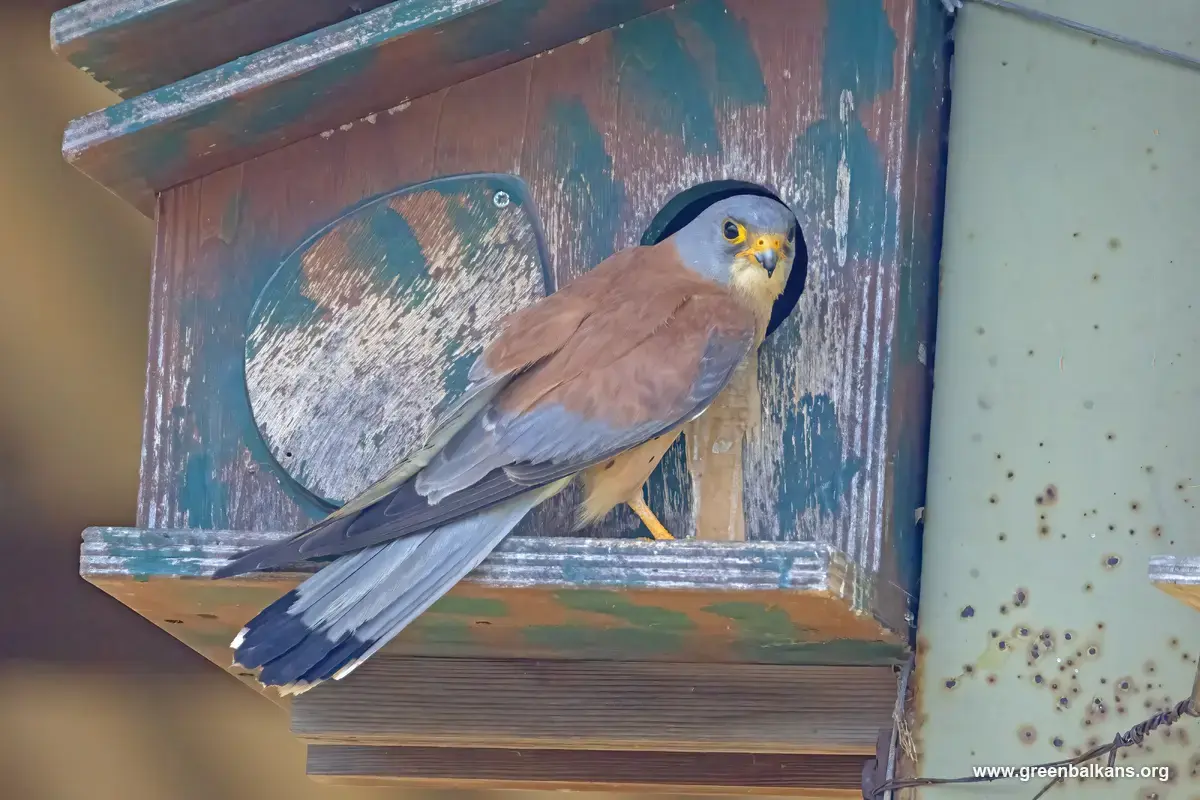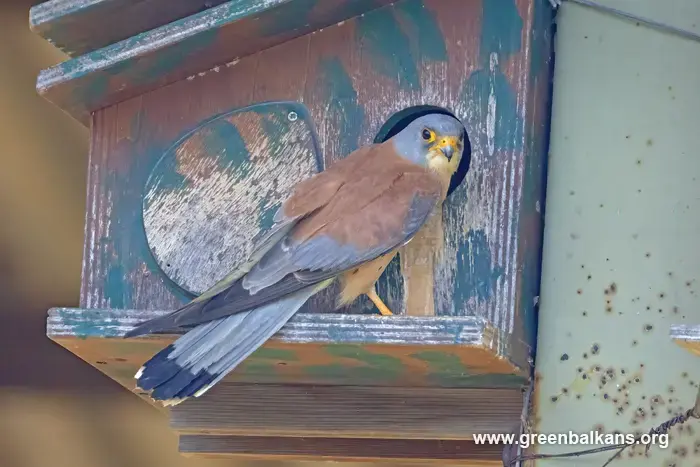
After years of dedicated efforts and nearly 2,000 marked birds, the moment conservationists had been eagerly awaiting has arrived – the first Lesser Kestrels from Bulgaria’s species recovery programme have been observed hundreds of kilometres away from the places where they were born. Two Lesser Kestrels, marked with colour rings as part of the project “Life for the Lesser Kestrel” (LIFE19 NAT/BG/001017), have been documented in Italy and on the Greek island of Crete. For the team of Green Balkans, these are the first documented international observations of birds hatched in the colonies restored in Bulgaria – an important sign that efforts to save one of the most threatened falcon species in the country are producing real results.
It is important to note that, until now, the Green Balkans team has already received valuable information about the movements of Lesser Kestrels through satellite tracking devices fitted to some birds within the project. These technologies have provided insights into migration routes, stopover and wintering areas, as well as the challenges birds face during their journeys. However, the current observations are particularly significant, as they represent the first documented encounters with living marked birds from the colonies restored in Bulgaria – birds identified by their colour rings by ornithologists in other countries.
The colour rings are not the only “identity cards” of these birds. Each Lesser Kestrel is also marked with a standard ornithological ring, and ringing data are collected and managed by the Bulgarian Ornithological Centre at the Bulgarian Academy of Sciences (BAS). After checking the ring codes in the database of the project “Life for the Lesser Kestrel” of Green Balkans, the origin of the birds was confirmed – the colonies where they were hatched and raised.
An encounter in Italy with an extraordinary bird
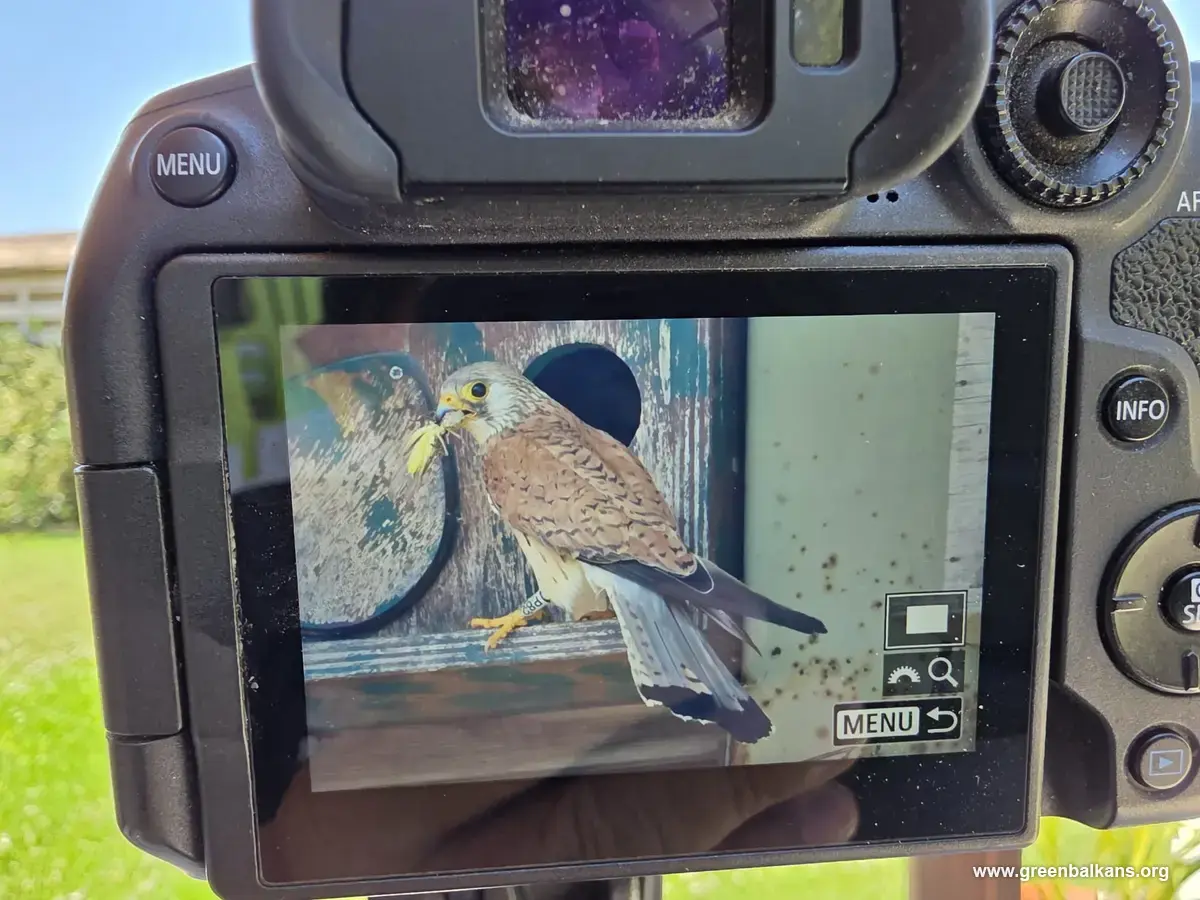
On 26 June 2026, Italian ornithologist Giuseppe Passacantando spotted and photographed a Lesser Kestrel carrying the colour ring P82 near Tarquinia, Viterbo, Italy. The information about this valuable observation reached the team of Green Balkans thanks to Adriano Talamelli, who is running a colour ringing program at Salina di Comacchio at the Po River Delta in Ferrara Province, Italy, and who shared the data and assisted with the identification of the bird.
After checking the ring code, it was revealed that the bird was born in Bulgaria, in the colony near the village of Levka, Sakar. It was ringed on 8 July 2023, when it was only around 20 days old. The discovery is even more remarkable because P82 has an unusual plumage coloration, making the bird easily recognisable.
The place where it was photographed also turned out to be a remarkable example of coexistence between people and nature – a guesthouse ''Naumanni'', named after the Lesser Kestrel, whose owners actively support the species' conservation by installing artificial nest boxes and undertaking other conservation activities. One of the largest colonies of Lesser kestrels in the area, with around 30 breeding pairs, is located near Guest House Naumanni, where the birds live in proximity to the property's visitors. The guest house team is also actively involved in the LIFE ENPLC (European Networks for Private Land Conservation) project, which promotes biodiversity conservation through cooperation with private landowners and managers.
Even more excitingly, the story of P82 does not end with its discovery in Italy. The bird has not only reached a new area – it has successfully settled there and become part of the local breeding population. P82 has formed a pair, and thanks to our Italian colleagues, we also have photographs of its partner.
The second “ambassador” – on the island of Crete
A little earlier, another piece of good news arrived from the island of Crete. In the area of Chania, ornithologist Robert Schallmann observed and photographed an adult male Lesser Kestrel carrying the ring Z12. The observation was entered into the relevant bird ringing database, from where the information reached the team of Green Balkans, thanks to Filios Akriotis from the Greek Bird Ringing Scheme, Biodiversity Conservation Laboratory.
This bird hatched in 2025 in the Lesser Kestrel colony located in the yard of the Wildlife Rescue Centre of Green Balkans in Stara Zagora. It is one of the three free-living colonies established as part of the programme to restore the species' breeding population in Bulgaria. The bird was ringed on 20 June 2025, when it was approximately 20 days old.
Two birds telling a much bigger story
To the general public, these may appear to be simply two interesting bird observations. For ornithologists, however, they represent invaluable scientific records. Every re-sighting of a marked bird is like a living page from a scientific diary. It reveals where the bird migrates, how it survives, and whether the colonies restored in Bulgaria have already become part of the natural European population of the species.
After years of work to restore the Lesser Kestrel in Bulgaria, these two encounters show that young birds not only leave their natal colonies and complete their migrations, but also become integrated into the wider network of Lesser Kestrel populations across Europe.
The team of Green Balkans expresses its sincere gratitude to Giuseppe Passacantando, Adriano Talamelli, Robert Schallmann, and Filios Akriotis. Their observations, photographs, and collaboration transformed two unexpected encounters into valuable scientific evidence of the success of the species recovery programme.
Sometimes, a single colour ring is enough to tell a story that began in Bulgaria and continued far beyond its borders. Because nature knows no boundaries. And these small Lesser Kestrels remind us that nature conservation is a mission that brings together people, countries, and efforts in the name of one shared cause.