As you know, the activities of Green Balkans are related to direct work with live animals, and this implies that our experts do not take into account national holidays, days off, vacations…. Are we out in the field researching Imperial Eagles, Vultures, Lesser Kestrels, Saker falcons, and others, or work in the aviaries of the Wildlife Rehabilitation and Breeding Centre, or even caring for herds of domestic animals, which we use to sustainably manage rare species habitats, or we're in front of a computer at the office - our biodiversity conservation efforts don't stop. This is so, including during days of celebration and fun for many people. Then we, too, continue our tireless work on behalf of Bulgarian nature.
And so, it was these days! Hours before the new year, our team received an alarming signal from the satellite transmitter of one of the Imperial Eagles, tracked by the team of project BESTbelt, realized with the financial support of the EU. The lightning verification in the field, in the region of the Upper Thracian Plain, found the dead bird under a power pole. After nidificating the competent authorities, the dead bird was immediately transported to the Wildlife Rehabilitation and Breeding Centre of Green Balkans for an autopsy.
Already with the admission of the eagle, the Center's veterinarians summarized, that one of the most common causes of mortality in Imperial Eagles is due to electrocution. The upcoming autopsy will show if this is also the case, but on the pre-examination the characteristic marks on the body are clearly visible. Although on the part of environmental organisations and electricity distribution companies, considerable efforts and resources are devoted to the securing of electric poles and wires in the country, but the negative tendency continues, and still most of the power distribution systems are not secured, and they continue to be a threat to various bird species.
For the team from Green Balkans, the loss of each of the individuals we work with is emotional, but in this case the fate of this eagle is extremely dramatic. The young Imperial Eagle was named Yambol, the name of the area from where in the summer of 2023, after it was found in a private yard in the vicinity of the town, he was admitted to the Rescue Center. After the first rehabilitation of the young bird, the team decided to apply an innovative methodology for the release of this species in the wild, and its return to natural conditions has been postponed until spring 2024. In this way, the experts hope to help the young eagle to survive one of the riskiest periods for this bird species – Juvenile dispersal after leaving their nests.
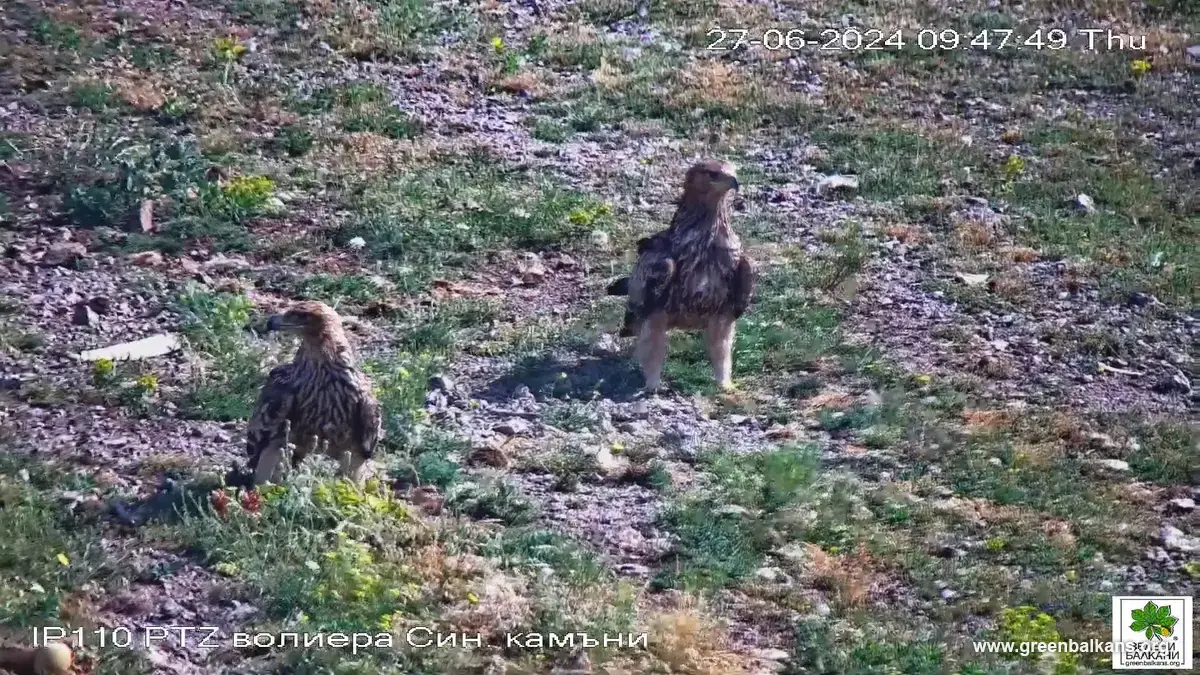
So, in the spring of 2024 Yambol together with another Imperial Eagle with a similar fate – Samuel were released in their natural conditions. The results are extremely encouraging and both birds are successfully adapting to an independent life in the wild, demonstrating the long-distance Juvenile dispersal characteristic of young birds of this species. The Imperial Eagle Yambol demonstrated attachment to the surroundings of Sliven and the territory of Nature Park “Sinite kamani”. There, he regularly benefits from the feeding of vultures on the specialised site maintained by Green Balkans on project "Bearded Vulture LIFE" (project #101113869 LIFE22-NAT-BG-Bearded Vulture LIFE). Not only that, but Yambol even proceeded to form a pair with another young bird of the same species, with which are frequent guests at the artificial feeding site.
And so, full of hopes, the Green Balkans team awaited in the coming years the eventual breeding of the two birds, but unfortunately, just on the eve of the New Year, the Imperial Eagle we were tracking died. However, the fact that the bird managed to adapt and survive in the wild for more than half a year, showed that the method chosen by Green Balkans is successful and gives good chances for adaptation to an independent life. Something that will be used for other patients of the Wildlife Rehabilitation and Breeding Centre of Green Balkans – the largest and most qualified wildlife hospital in Bulgaria.
The tracking with satellite transmitters of the two eagles described above, is part of the activities of project BESTbelt, implemented with the financial support of the European Union, implemented by Green Balkans in partnership with the Turkish organisation "Back to Nature" and the German Foundation EuroNatur. The project is aimed at conservation, support and research of rare and protected bird species – the Lesser Kestrel and the Imperial Eagle in the border regions of Bulgaria and Turkey, including Sakar, Dervent Heights and Strandzha, part of the European ecological network NATURA 2000. Key habitats for both species are concentrated in the border areas, covered by the former Iron Curtain and today united in the international European Green Belt initiative.
For more information:
Dr. Gradimir Gradev, project manager, Green Balkans
e-mail: ggradev@greenbalkans.org
tel.: +359885 609 289