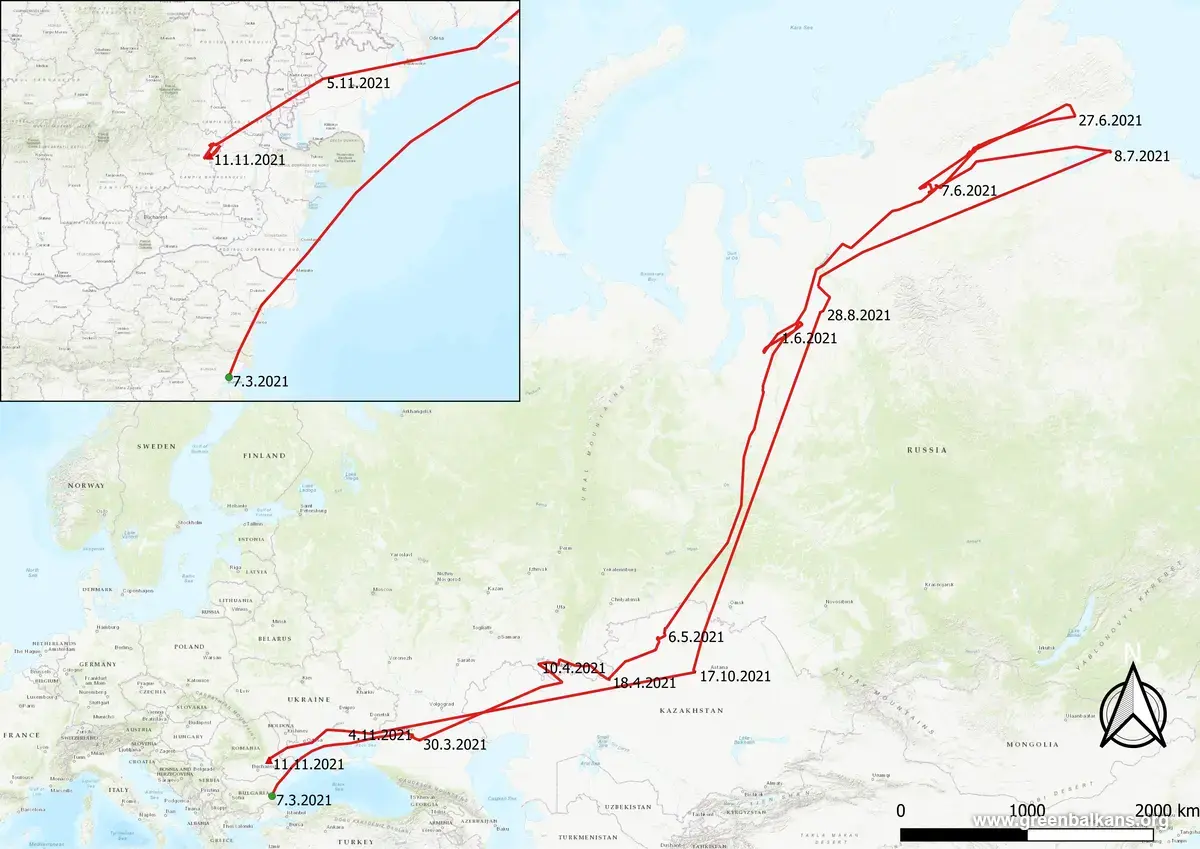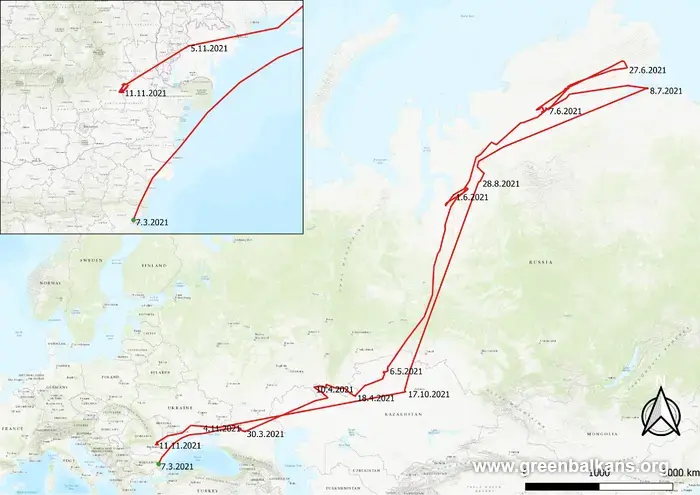
That is the distance flown by a Greater White-fronted goose (Anser albifrons) tagged by our team in the beginning of March with satellite transmitter. The bird was rehabilitated in the wildlife Rescue Centre and released on 7th March close to Atanasovsko Lake where one of the last wintering geese flocks in the country remained. That has proven to be just in time as less than 48 hours later the flock flew North.
First stage of migration was more than impressive as the goose flew more than 1285 km crossing northern part of the Black Sea, Sea of Azov and reaching Manych River achieving a top speed over 100 km/h and altitude of more than 1000 m in due course. The bird stayed in that area until the end of March recovering its strengths and accumulating energy reserves for the upcoming stages of the long flight East and North. In the beginning of April, the goose flew along Ural River and continued its route to the East entering Kazakhstan and staying in the vicinity of Ishim River. Migration further North continued in the mid-May by reaching the sea coast where Pur and Taz River flow into Gulf of Ob, Kara Sea. Better part of June the bird spent in the Taymyr Reserve of the same peninsula flying about more than 1400 km. In the beginning of July, the goose settled on the bank of one of the million tundra lakes close to the shore of the Arctic Ocean. That is the most probable nesting site as the bird spent there almost two months before moving West and then South in the end of August.
In the mid-October it has reached Kazakhstan passing at only 100 km to the west of the capital Astana. On 4th November it was already on the Sea of Azov coast around Mariupol in Ukraine continuing its flight to the West and reaching the Balta Alba Lake in Romania in the early afternoon of the next day. Since then, the bird is roosting in different lakes of Buzau District. For that period of eight months the goose flew more than 16 000 km. This story illustrates the beauty and amazing power of nature and reminds us that it is our duty to protect it from negative influences so as not to lose it forever.
Contacts:
Dimitar Popov: dpopov@greenbalkans.org