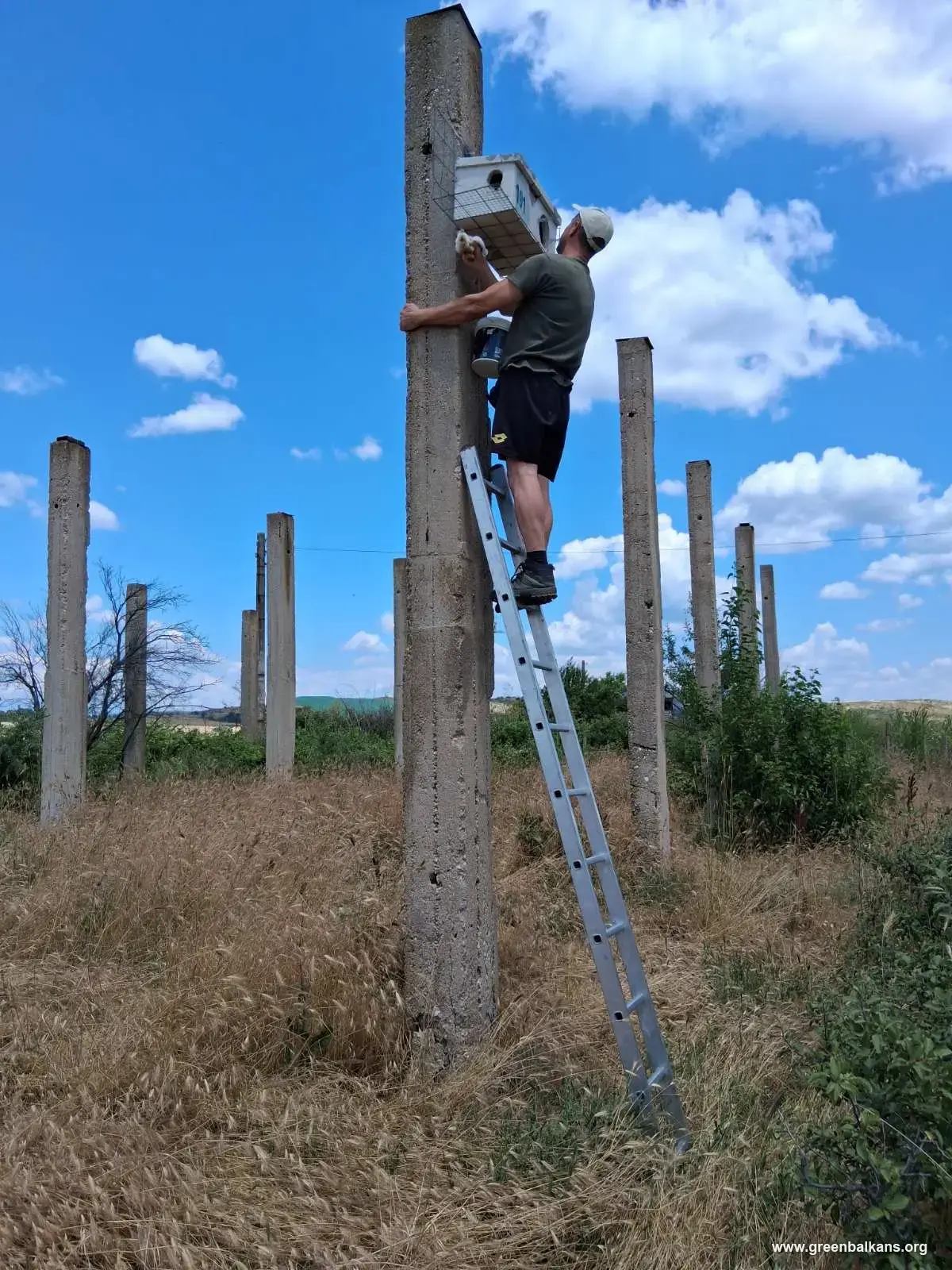
Today, experts from the project “LIFE for the Lesser Kestrel” (LIFE19 NAT/BG/001017) ringed young lesser kestrels hatched this year in the breeding colony near the village of Levka in the Sakar Mountains. With this latest fieldwork, the total number of birds ringed since the beginning of the species recovery programme in Bulgaria has now exceeded 2,000 individuals.
Bird ringing is one of the most important tools in modern bird conservation. It allows scientists to track migration routes, survival rates, reproduction, and dispersal of individual birds. The data collected provide valuable insights for assessing the success of conservation actions and for planning future measures to protect the species.
Each bird receives two rings: a standard metal ring with a unique identification number and a colour ring that allows individuals to be identified from a distance without the need for recapture. This colour-marking system for lesser kestrels was introduced in Bulgaria for the first time by the project team.
The restoration programme began in 2013, when the first young birds were brought to Bulgaria by the Spanish partner organisation DEMA. Since then, the initiative has developed successfully through strong international cooperation and continuous efforts to restore the species in the country.
In addition to birds hatched in the breeding colonies in Levka, Kliment, and Stara Zagora, the programme also includes individuals raised at the Sofia Zoo, as well as birds provided over the years by zoos in Prague and Hodonín, Czech Republic. After release, these birds successfully adapt to the wild, where they hunt, migrate, and breed alongside the wild population.
The results clearly demonstrate that conservation efforts for the lesser kestrel are delivering real impact. The species is not only returning to Bulgaria but is gradually establishing self-sustaining wild populations – an important step towards its long-term conservation and the restoration of the country’s natural heritage.