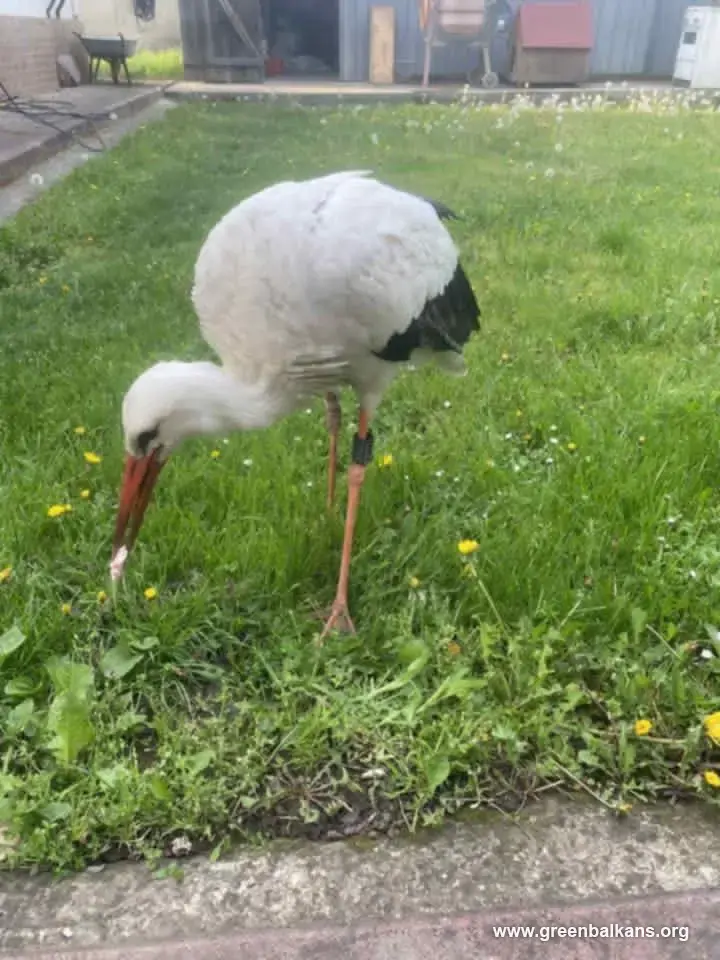
The story of three white storks, ringed and tracked with GPS transmitters by the team of Green Balkans, reveals how different the fates of birds can be, even when they appear to follow the same migratory route. From long-distance migrants crossing continents to individuals choosing to remain close to people, each bird tells a unique story of adaptation and survival.
Stork Anton: an unusual choice – a life among humans
The well-known stork Anton continues to surprise the project team with his behaviour and unusual choices. After a period of social interaction with people in Moldova, he successfully reached Ukraine and settled in the area of the village of Dubivtsi, in the southwestern part of the country.
There, Anton displays a highly unusual behaviour for the species – a strong affinity for the human environment. He is often seen walking in the courtyard of a local family and calmly “coexisting” with their domestic chickens, as if he were part of the household.
Following a field inspection by partner teams, it was established that his transmitter had been displaced. As a result, the device detached, while observations of the bird’s behaviour continue to be collected through field data and local reports.
All of this has been made possible thanks to the dedicated support and collaboration of our colleagues and friends from Ukraine – Nazar Smyrnov from the Chernivtsi Regional Museum and Pavlo Gol'din from the Schmalhausen Institute of Zoology, National Academy of Sciences of Ukraine. Despite the constant threats and uncertainty posed by the war, our partners and local people there continue to show remarkable compassion and responsibility toward nature. Even under these extremely difficult circumstances, they remain dedicated to caring for the birds, demonstrating that humanity and respect for life endure even in the darkest of times.
Two birds, one start, different destinies
At the beginning of May, during the international meeting of the “European Stork Villages” initiative in the village of Belozem, two white storks were released after completing rehabilitation at the Wildlife Rescue Centre in Stara Zagora.
Both birds arrived at the centre from the Ruse region via the Regional Inspectorate of Environment and Water (RIEW–Ruse) – one in August 2025 and the other in March this year. Despite their similar starting point, they followed entirely different paths after release.
The bird of the northern winds
The younger bird headed decisively north. It successfully crossed the Carpathian Mountains and, after several days waiting for favourable weather conditions, continued its journey to the village of Kölcse in northeastern Hungary.
There, it settled in the area and likely occupied an existing nest – an important sign of successful adaptation and orientation in a new environment.
The bird that chose to stay in Belozem
The other bird followed a different strategy – instead of continuing its migration, it remained in the Belozem area, one of the most emblematic “European Stork Villages”.
It is regularly observed near the waste treatment plant in the village of Shishmantsi, as well as along the Maritsa River – areas that provide a stable food supply. In recent days, the bird has also been staying near a cattle farm close to the village of Popovitsa.
A team of experts is expected to conduct a field inspection to assess its condition and behaviour in its natural environment.
What do these three stories tell us?
The three storks outline three different life scenarios – from long-distance migration across thousands of kilometres, through adaptation to new habitats, to an unusual proximity to human environments.
They demonstrate that behind a seemingly uniform migratory journey lie complex individual decisions, behavioural strategies, and responses to a changing world.
GPS tracking remains an indispensable tool that allows scientists to uncover these hidden stories – and to better understand the life of birds, as well as the challenges they face during migration, breeding, and coexistence with humans.
The white stork tracking via GPS transmitters is carried out thanks to the support of our partners from “FUTURE – You & The Planet”.