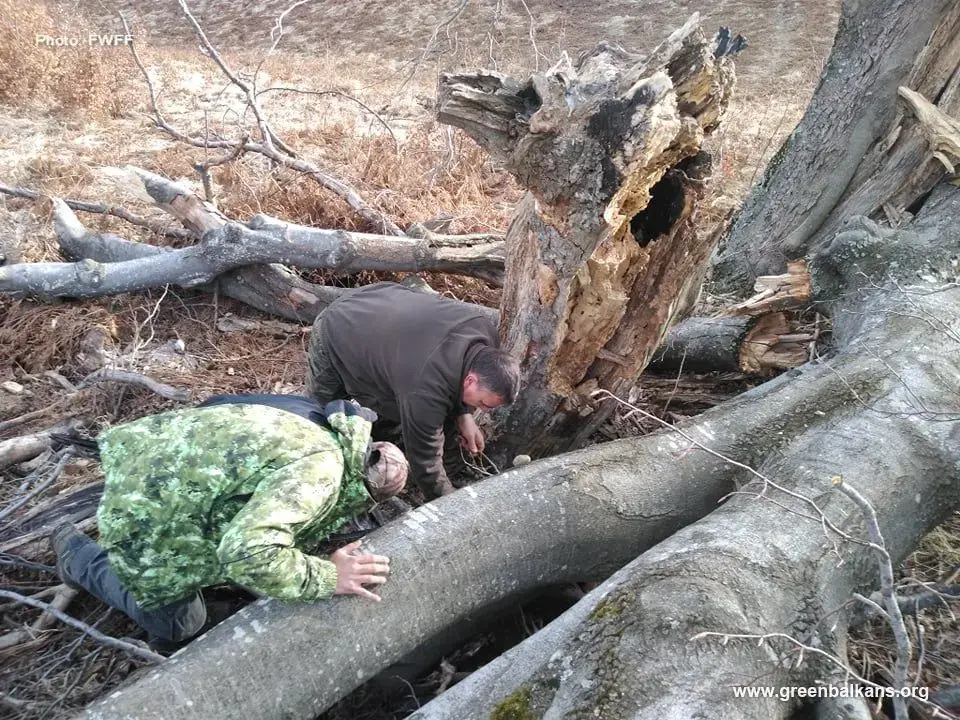
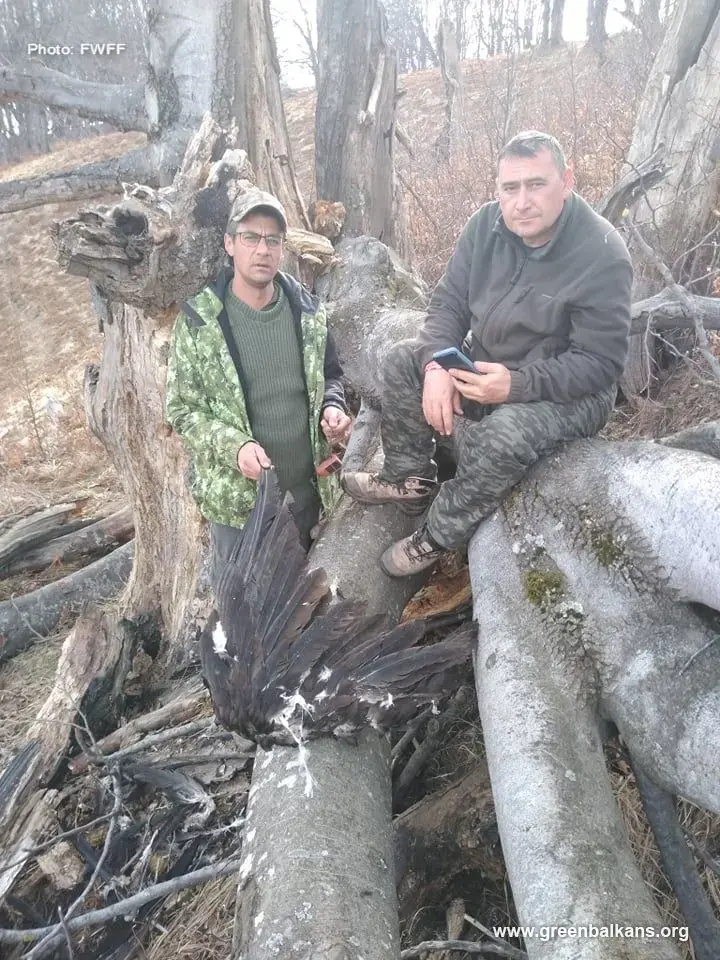
Unfortunately, natural disasters kill not only us people. This was the reason for the death of one of the “priceless birds”, reintroduced from Spain and a hope for the Black Vulture return in our country. For more than 2 months Marina’s tag wasn’t sending any GPS data and her last observation was on 23 January 2021. After a long search on site of Kotel Mountain her tag sent a signal and the Fund for Wild Flora and Fauna (FWFF) team finally found what happened to the young Black Vulture female. On the morning of December 28, after a heavy storm and strong wind passed in the area, a giant beech tree fell on the bird, resulting in Marina’s death.
This loss caused a significant blow to the efforts to reintroduce the species in our country that went extinct in the 90s, especially since Marina was considered as a promising vulture with big potential to breed in the next few years.
Under the fallen tree branches, the team discovered the GPS tag alongside the bird's remains that appear to have been eaten by a fox. For several months this site was traditionally used by the formed pair of Marina and Zlosten. Luckily, Zlosten, another Black Vulture reintroduced from Spain, who was also using the site, remained alive and unaffected.
Under the fallen tree branches, the team discovered the GPS tag alongside the bird's remains that appear to have been eaten by a fox. For several months this site was traditionally used by the formed pair of Marina and Zlosten. Luckily, Zlosten, another Black Vulture reintroduced from Spain, who was also using the site, remained alive and unaffected.
Such a tragic event is a terrible accident, but unfortunately, the reintroduced birds are endangered by many natural and human factors and many of them die, despite all care taken. That is why species reintroduction is an extremely difficult and long lasting goal that requires a lot of time and efforts.
It is a great loss for the Black Vulture reintroduction project as this was one of the three first formed pairs in the country and there was also a big possibility to be the first to breed in the wild in Bulgaria this year for the first time since the species' extinction in the 1990s.
The Bright Future for Black Vulture project is deeply saddened by Marina’s death but will overcome this loss and will continue to work diligently and devotedly until the successful breeding of this species in Bulgaria!
Additional information
The story of the reintroduced vulture Marina
As well as releasing captive-bred birds, the Bright Future for Black Vulture project mainly releases young Black Vultures that were rescued and rehabilitated in the Los Hornos and AMUS centres in Spain and are donated to the project by the Junta de Extremadura. After these birds quarantine in AMUS, they are transferred to Bulgaria for their eventual release, an action coordinated by the Vulture Conservation Foundation (VCF). Marina, a female Black Vulture, was part of the first transport group in 2018, where 12 birds arrived from Spain. The project team released Marina shortly after in Kotel, situated in the Balkan Mountains. She was one of the first birds to be released in the hope to establish a nesting population in the country in the coming years. Ever since her release, she has been successfully exploring Kotel, making short excursions around the surrounding area.
Bright Future for Black Vulture LIFE14/NAT/BG/649 projectIt is a great loss for the Black Vulture reintroduction project as this was one of the three first formed pairs in the country and there was also a big possibility to be the first to breed in the wild in Bulgaria this year for the first time since the species' extinction in the 1990s.
The Bright Future for Black Vulture project is deeply saddened by Marina’s death but will overcome this loss and will continue to work diligently and devotedly until the successful breeding of this species in Bulgaria!
Additional information
The story of the reintroduced vulture Marina
As well as releasing captive-bred birds, the Bright Future for Black Vulture project mainly releases young Black Vultures that were rescued and rehabilitated in the Los Hornos and AMUS centres in Spain and are donated to the project by the Junta de Extremadura. After these birds quarantine in AMUS, they are transferred to Bulgaria for their eventual release, an action coordinated by the Vulture Conservation Foundation (VCF). Marina, a female Black Vulture, was part of the first transport group in 2018, where 12 birds arrived from Spain. The project team released Marina shortly after in Kotel, situated in the Balkan Mountains. She was one of the first birds to be released in the hope to establish a nesting population in the country in the coming years. Ever since her release, she has been successfully exploring Kotel, making short excursions around the surrounding area.
Led by the Green Balkans NGO, with activities also implemented by the Fund for Wild Flora and Fauna, and bringing together partners from Bulgaria, Spain and Germany, Bright Future for Black Vulture LIFE14/NAT/BG/649 aims to reintroduce the Black Vulture to Bulgaria. The team will transfer and release around 60 birds, some from captive-breeding, but mostly coming from wildlife rehabilitation centers in Extremadura (Spain) into the wild in Bulgaria as well as creating supplementary feeding stations and improving populations of wild herbivores, improving the nesting conditions and creating artificial nest sites and tackling some of the major threats to vultures in the country such as insulating electricity pylons and illegal use of poison in the nature.
Photos: Fund for Wild Flora and Fauna (FWFF)